
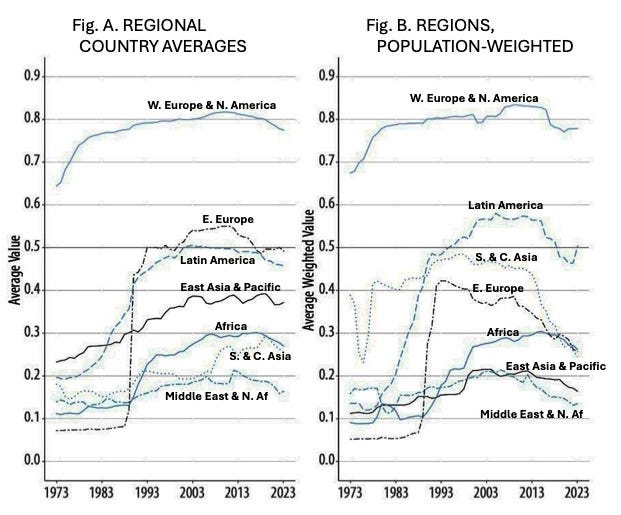
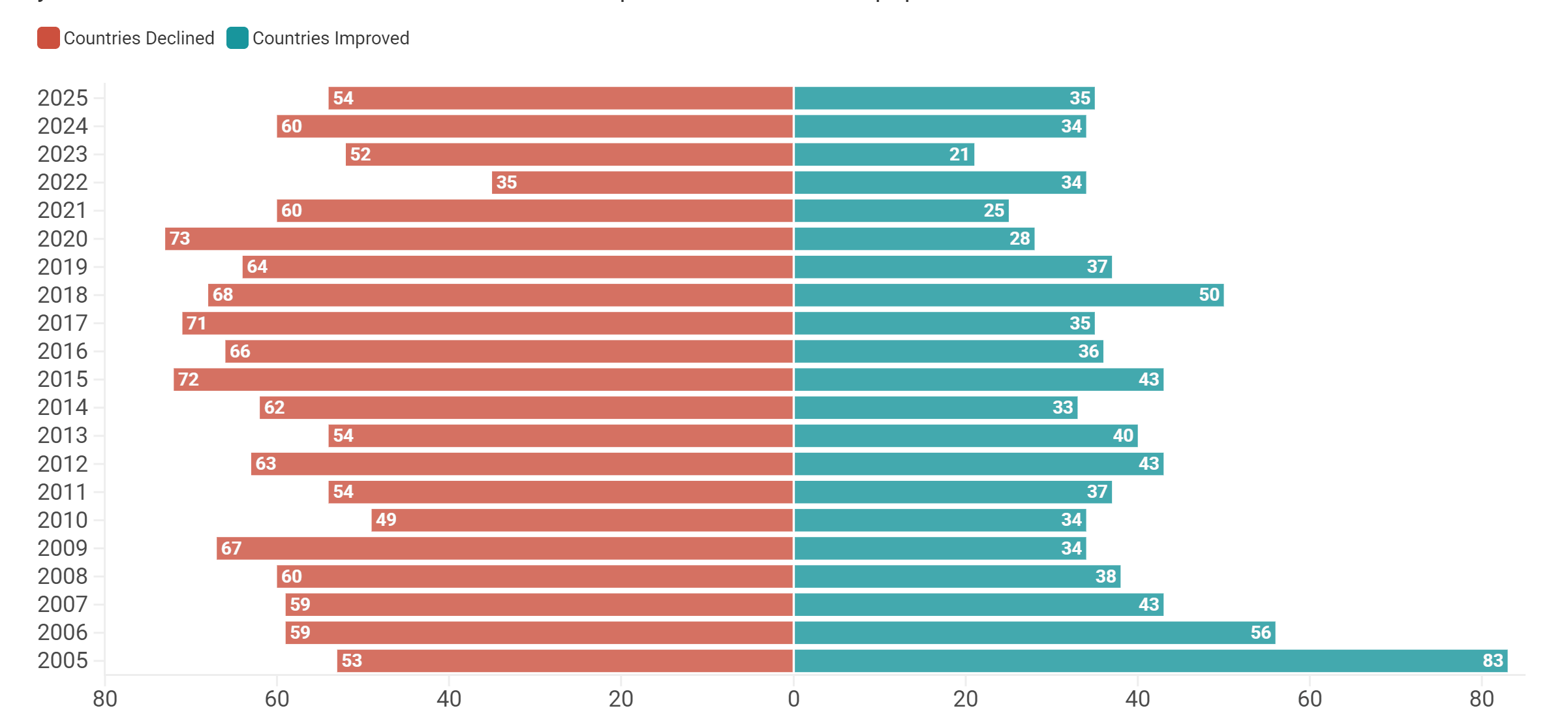
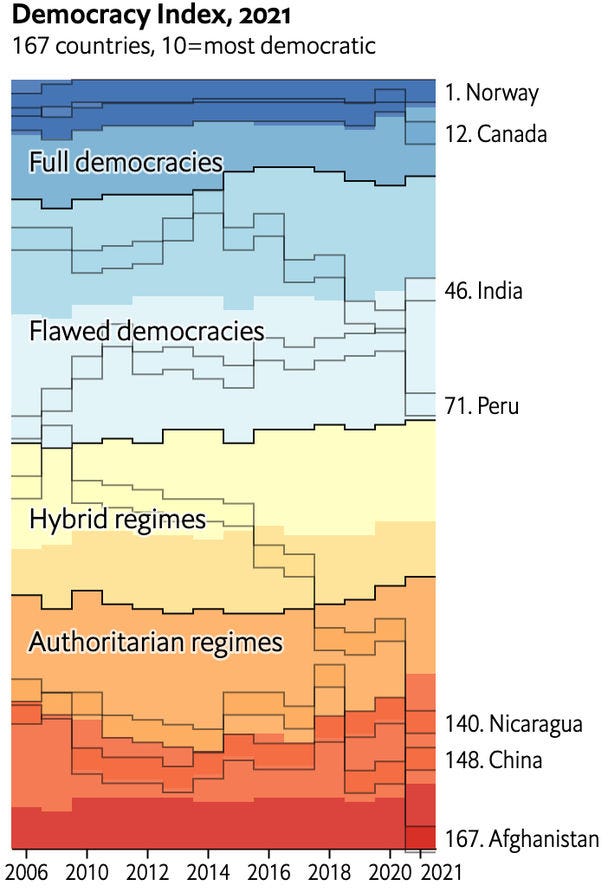
Since 2015, there’s been a lot of worry about democratic backsliding/decline. The populist right has been ascendant all around the world, and they seem to care a lot less about democratic norms and rule of law. This has led to “democracy indices”, surveys where political scientists are asked to rate countries they study on various aspects of liberal democracy, falling worldwide.
Here is VDem:
Here is Freedom House:
Here is EIU:
At the same time, there has been substantial pushback from some in poli sci, most notably in a 2024 paper by Andrew Little and Anne Meng. They point out that democracy indices are all subjective metrics, and that objective metrics – most significantly, how often governing parties are re-elected – haven’t changed much in the past decade. Some academics who were concerned about democratic decline and cited Hungary as a prime example have started to wonder whether they overstated that decline in the wake of Peter Magyar’s election.
I have always found this discussion to be missing something. There’s this picture of democracy that I’ve kind of always had, and which has become clearer in my mind the last few years, that changes the way to think about democratic decline. In this post, I’ll lay out this picture and talk about its specific consequences for assessing US democracy.
A Picture of Democracy
This picture is of democracy as a popularity contest of policies. So a country’s political system is democratic to the extent that it favors more popular policies; ie, to the extent that it causes more popular policies to be enacted. The main rationale for democracy under this picture is that the more popular policies tend to be better, although in this post I’m more interested in what it means to be democratic.
“Favors more popular policies” is intentionally ambiguous – does that mean the single most popular policy gets enacted? Or that different policies get enacted simultaneously relative to how popular they are? And what exactly do we mean by “policy”; how do we draw the line between different policies? These are all good questions that often come up when comparing democratic systems. But what unites all these democratic systems, the core idea behind what it means to be democratic, is that more popular policies are favored.
I also intentionally phrased it as a “political system” which “causes more popular policies to be enacted”, rather than like “a government where more popular policies are enacted more”. I’m focused here on democratic systems rather than democratic outcomes. This means I generally won’t consider claims of the form “the people in power have views unpopular in issue polling, so it’s undemocratic” unless they’re backed up by a systemic mechanism, which should then be assessed on its own terms. See this footnote for more discussion of this nuance.1
This is, I hope, a pretty intuitive picture. But it’s importantly different from other pictures of democracy I’ve heard repeated, like democracy as free and fair political processes, or democracy as everyone having equal political power. These other pictures, while intuitive in their own respects, aren’t a very useful guide when it comes to assessing how democratic a government is. “Free and fair” is of course just begging the question (what is “free” and “fair”?), and it seems like we should have some underlying intuitive idea that guides us rather than intricately defining “free” and “fair”. Equal political power just isn’t that helpful when it comes to things like complicated electoral systems or disqualifying opposition candidates. It’s often clear when something undemocratic is going on in these cases, even if it’s awkward to define who exactly is being given unequal political power.
This “popularity contest of policies” picture makes discussion of democratic decline much clearer and less subjective. Orban’s Hungary is a good example. My understanding of the rough political situation there is that they held legitimate elections but had limited press/speech freedom. So opposition candidates appeared on the ballot, their votes were actually counted, and they would be seated if they won. However, the speech in society was heavily censored, which limited the ability of voters to hear the opposition candidates’ messages.
This situation can be confusing to evaluate from a democracy perspective. You probably wouldn’t classify it as fully democratic or fully undemocratic. But where along the spectrum is it? Without an underlying vision of democracy, the best you can do is give a 0-10 rating on every aspect of democracy and then average these ratings somehow. Why would we expect that to be at all an accurate measure of what we care about?
“Popularity contest of policies” provides a clear picture of how to assess this situation. The relevant question is how much the deck is stacked against certain policies, how much less likely they are to be enacted as a result of the censorship. For most undemocratic mechanisms, including censorship2, there are two ways they skew the contest:
Making it more likely that the parties advocating those policies (usually the governing party/parties) will be elected.
Allowing these parties to advocate more extreme versions of those policies, and forcing other parties to be more moderate in opposing those policies, for elections to be competitive.
This moderation and extremism don’t have to be intentional, it can be unconscious learned behavior from past political situations or from polls. This is particularly true of extremism, as it’s often the case that people want to get more extreme, so if the system allows for it they will naturally do so.
The first bullet point is easier to measure, and Little and Meng are correct to point it out as one important metric when it comes to analyzing democracy. But it alone is not the full story. It could be that governments are just as likely to be re-elected, but that is only because the government is able to be more extreme and the opposition forced to be more moderate. You need a sense for the second bullet point to evaluate the situation fully.
That second bullet point is hard to measure. I don’t expect a single empirical metric to perfectly capture it. But that’s why we turn to experts like political scientists! These are the two points they should be looking to assess, by whatever means they can! My sense is that this has gotten lost, that democracy raters tend to value procedure for the sake of procedure instead of how that procedure affects the popularity contest of policies. My hunch is that many intuitively undemocratic actions – say, the use of state resources for campaign activities – actually have fairly limited effect on the popularity contest of policies.
Consequences for US Politics
Now I want to discuss some of the specific consequences of this picture of democracy, to give a better sense of the type of reasoning it involves. I’m going to focus on the US, seeing as it’s the place I’m most familiar with as well as probably the most important instance of (alleged) democratic decline. I’m going to focus on the two biggest issues facing US democracy in my view: structural bias – the US electoral systems for the House, Senate, and Presidency all being biased toward Republicans – and Republican threats to steal elections.
These aren’t the only two issues facing US democracy. Other issues include Republicans’ attempts to make it harder for people to vote (with pretty open intentions), the Trump administration’s constant violations of free speech by punishing private actors who oppose them, and (as a left-wing example) attempts by bureaucracy to push left-wing policy beyond what those at the top would like. But my sense is that these other issues don’t affect the popularity contest of policies nearly as much:
The partisan effect of making it harder for people to vote is not very large, and these days it probably actually helps Democrats
I think private actors like business leaders, universities, or lawyers speaking out against Trump during his first term was useless-to-actively-harmful because it just reinforced the image that Trump was taking on the liberal elites. This term, in part because of Trump silencing elite critics, I think Democrats have been able to more effectively paint the picture that Trump is on the side of rich elites rather than working people.
Congress can loosen civil service protections by statutory law to give presidents greater control over the bureaucracy, so this isn’t much of a systemic issue. And actually, Trump’s effort to cleanse the bureaucracy illegally this term through DOGE was itself unpopular, which suggests to me that bureaucrats’ work is often implicitly popular. (Obviously there are many reasons it was unpopular, including its illegality, but still).
Structural bias and election theft, by contrast, are issues where I am confident the undemocratic effect is large.
Structural Bias
In a two party system with most issues split along party lines, like we have in the US, there are two main “quantities” that determine how undemocratic an electoral system is: I call them “majority partisan bias” and “election policy elasticity”. The majority partisan bias of a system is how much one party needs to win the popular vote by to get a majority. The election policy elasticity is how sensitive voters are to the issue positions of candidates, how many voters would switch their vote from party A to party B for some fixed amount of A moderation / B extremism.
(This “amount” is measured in something like “policy units”, which is going to introduce subjectivity in how important you think specific policy shifts are. I think we should aim to evaluate the importance for voters, as opposed to our own values. And note that “voters” here means all voters, not just swing voters who change their vote because of it, as obviously that would be circular.)
When the majority partisan bias is higher (biased toward party A) and election policy elasticity is lower, party A’s policies are at more of an advantage. Like with censorship in the previous section, this is because party A is more likely to win elections, and because party A is able to be more extreme (and party B forced to be more moderate) for elections to be competitive. (The latter by an amount that’s roughly majority partisan bias ÷ election policy elasticity).
These are, of course, somewhat oversimplified abstractions of what actually goes on in any election. But I think they’re relatively coherent. As I’ll discuss in a bit, you can empirically measure the majority partisan bias in a predictive way, which suggests it is defensible to speak roughly about it. Election policy elasticity is somewhat less coherent to speak about as a single quantity - elections are determined by many different issues, each of which may affect the popular vote margin a different amount - but you can mostly extend the logic here to each issue individually, ie each issue having its own “election policy elasticity”. I think this issue-specific version models real elections well; in this piece I’m sticking with one overall elasticity mostly to get the point across.
Metrics
For the House of Representatives, a good metric of the majority partisan bias is the mean-median gap: the difference between the overall popular vote margin (Republican vote % - Democrat vote %, adding up all the districts) and the margin in the median district. The best way to measure mean-median is at the presidential level, so that individual candidate quality doesn’t confound it.
If the mean-median gap stays fixed, no matter what any of the candidates do, then the mean-median gap will line up with the majority partisan bias. This is because (if House elections exactly match presidential margins) the median district always determines which side gets a majority:
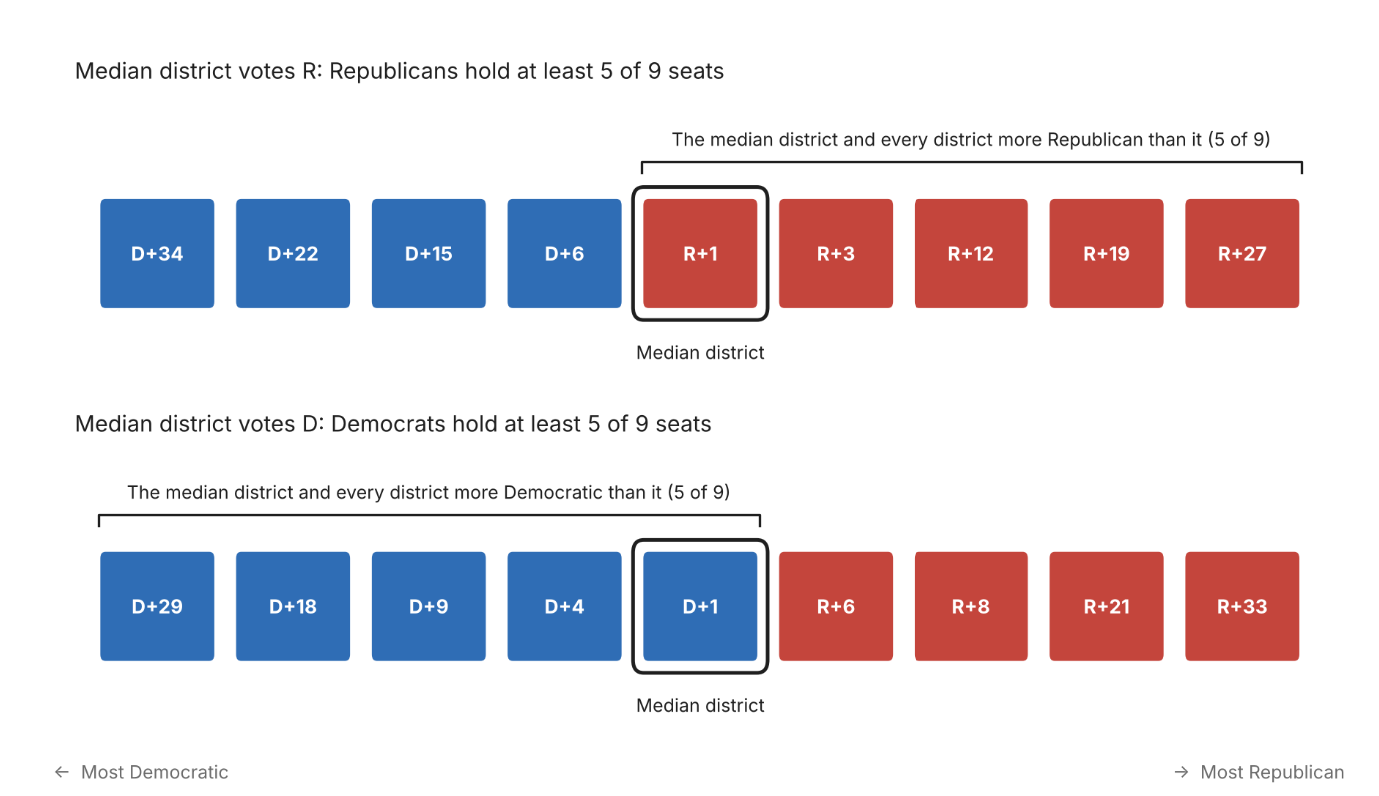
And its margin is exactly popular vote margin + mean-median gap:
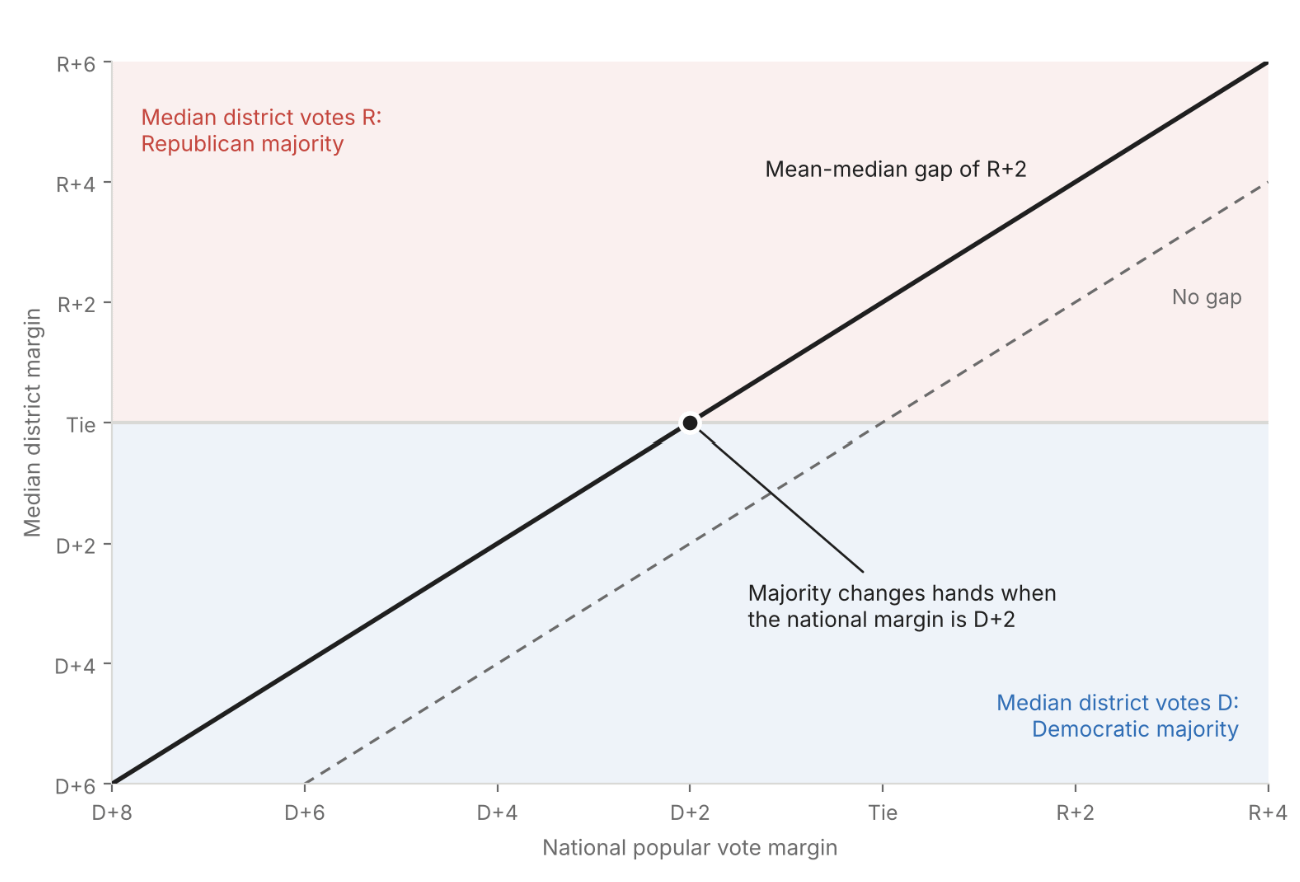
So a fixed R+2 mean-median gap corresponds to a R+2 majority partisan bias, which means that Democrats need to win by >2% to get a majority and otherwise Republicans will get one. In reality, because districts can trend in different directions, the mean-median gap doesn’t stay exactly fixed. Empirically, though, it doesn’t change that much. Here I plotted the mean-median gap for the Congressional districts drawn in 2012 across all presidential elections from 2008 to 2020:
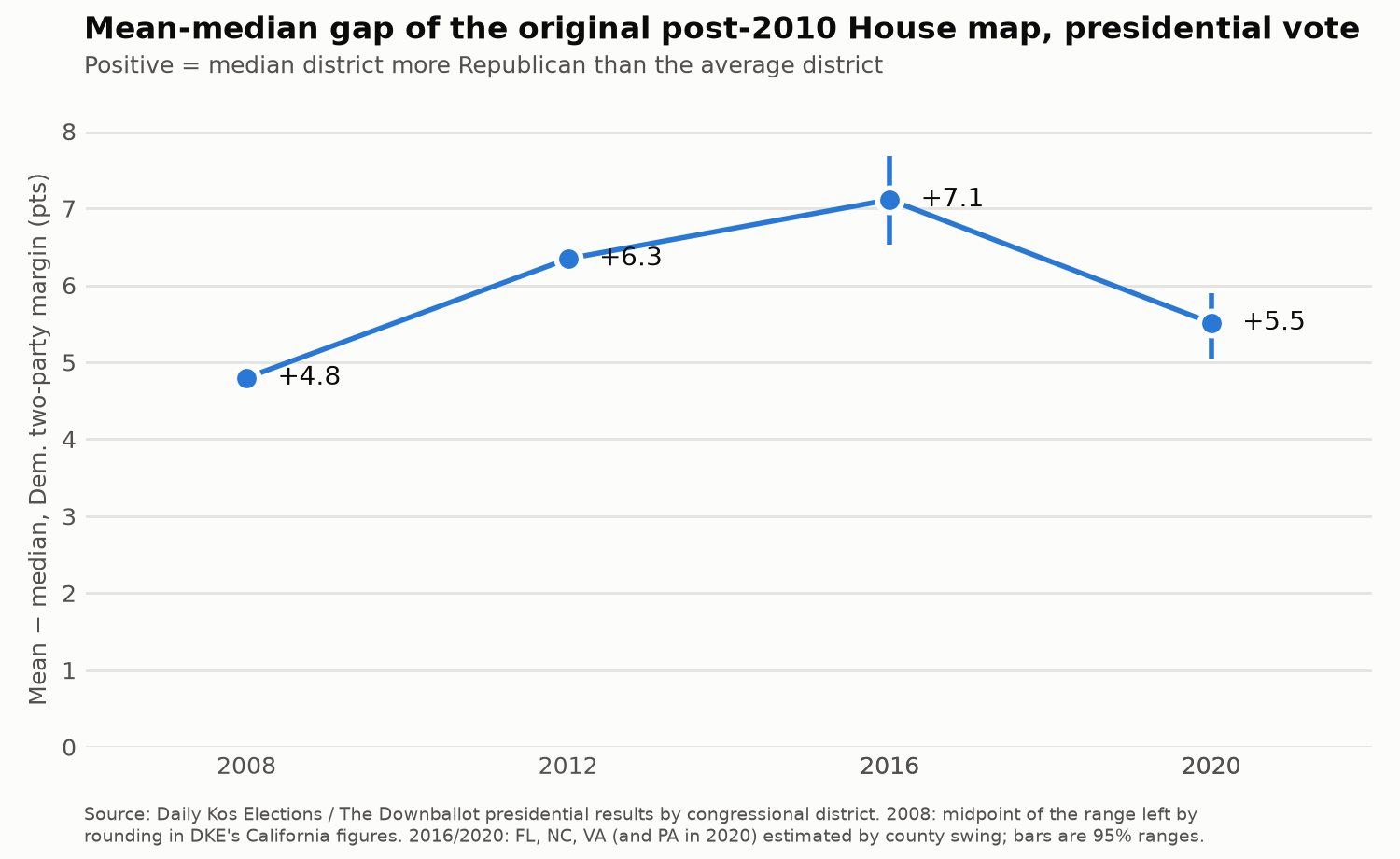
The mean-median gap in the current map (after 2020 and then mid-decade redistricting) is a bit lower but still R-biased, at around R+3. This is because Republicans have more favorable geography and have been more willing to gerrymander than Democrats. (Though certainly Democrats have gerrymandered in many states.)
You can extend this mean-median logic to the Senate map, looking at states rather than districts, although it’s even less coherent to speak of a single “majority partisan bias” there given that only 1/3 of senators are elected each cycle. The mean-median gap in the 2024 election was either R+1.7 or R+4.0 (depending on which side holds the presidency, which is the tiebreaker in the Senate for majority control). But this mean-median gap actually understates the Senate’s skew substantially, because 24 states voted for Trump by >10% in the 2024 election compared to just 13 voting for Harris by >10%.
Democrats’ two ways of winning the Senate are essentially “win by a decent amount (>2%) three cycles in a row and run solid candidates in every swing state” or “win a few seats in R+10 states, and then run solid candidates in most swing states”. The former is harder than it seems, given that it includes one presidential election and its subsequent midterm, which usually have opposite popular-vote margins due to midterm backlash. The latter strategy is why Democrats have been at all competitive in recent years.
(This all stems from the fact that the Senate doesn’t even try to treat people equally, instead giving each state 2 seats regardless of population. This is quite undemocratic in a world where the left-right spectrum is (evidently) far more important to voters than the state-specific concerns that motivated this system. And even taking those concerns seriously, this is not a sensible way of making sure smaller states’ voices are heard.)
The Electoral College is more complicated, in that it’s a bizarre system whose mean-median gap (also called the tipping point state lean) is pretty erratic. But it has favored Republicans for the last 3 presidential elections (2016: R+3, 2020: R+4, 2024: R+0.3) and seems likely to continue to do so for the time being.
Election policy elasticity is much harder to measure, but I think you can get a sense of it by analyzing the policy positions and electoral performance of specific House or Senate candidates. You can also do some more quantitative stuff like compare performance of representatives who sit in different “caucuses” (like Progressive Caucus, Blue Dog Democrats, etc.) or who get funding from different organizations. See this post for a good example of this type of analysis.
Election Theft
Trump tried really hard to steal the 2020 election, and Republicans have given not-so-subtle hints that they will try to steal the next one. The two most plausible theories I’ve heard for how they would steal an election are finding some BS excuse to throw out ballots after the fact, and directly messing with the certification process to create confusion and throw the election into the House (which Republicans are almost sure to win3). They tried both in 2020 and got pretty far.
For a while, I was pretty confused about how to think about structural bias and election theft together. They seem like such different concerns, and yet both viscerally undemocratic in their own way. Which one is a bigger threat? How can we talk about both of them in a way that doesn’t confuse people?
“Popularity contest of policies” provides very compelling answers. The question to ask for each of them is how much they affect which policies get implemented. Structural bias does this by making Republicans more likely to win elections and allowing Republicans to be more extreme / forcing Democrats to moderate for elections to be competitive. Similarly, election theft makes Republicans more likely to win elections (depending on how likely Republicans are to steal them).
What made all this really click for me was realizing that election theft is also affected by margin of victory, and therefore also has some of the same effect of allowing Republicans to be more extreme / forcing Democrats to be more moderate! This is because it’s harder to steal landslides than close elections, for a bunch of reasons:
The margin in terms of raw ballots is a lot higher, so it’s harder to find an excuse to throw out enough ballots to overturn the election.
There’s a good argument that the Florida and US Supreme Courts in 2000 stole the election for Bush, and the reason they were able to do so is that the margin in Florida was close enough that slightly biasing the recount rules was able to swing things
The electoral vote margin is larger, so you have to meddle with more states in order to successfully overturn things. There’s a higher chance that officials in some states would be more principled and resist the scheme.
There’s less likely to be a “red mirage” on election night, where Republicans initially seem ahead in the count before mail ballots are counted. This dynamic makes people suspicious of the results and thus less likely to see through election theft.
You can therefore think of election theft as a form of bias. It’s a far more random one than structural bias - it’s not certain that a close election will be stolen or that a landslide will not be - but it’s bias nonetheless. You can then analyze it in the same way as structural bias: the two relevant quantities are the “slope” of the probability of theft vs. margin of victory “line”, and the election policy elasticity. It is of course much harder to estimate that slope, but this is the underlying thing you should be trying to get at as part of evaluating how democratic the US currently is.
(The ideological consequences of election theft tend to be unconscious learned behavior rather than intentional behavior. It’s mostly not the case that Democrats think “we have to win by a lot so that Republicans can’t steal the election” or Republicans think “we can afford to be more extreme because we can steal close elections”.4)
This may feel like I led you down a bit of a rabbit hole. Sure, the “popularity contest of policies” picture is intuitive, but do we really have to embrace all of these complicated and often unintuitive consequences?
The point I want to drive home is that I’m talking about real causal effects. It is actually true that structural bias and election theft make it easier for Republicans to win elections and allow Republicans to be more extreme / force Democrats to be more moderate. I believe it’s actually true that the silencing of anti-Trump elite voices doesn’t give the Trump administration much of a leg up. These are all (I believe) descriptively accurate descriptions of what is going on.
You could argue that this isn’t really how we should evaluate these actions’ democratic effect, or at least not to the point of outweighing common-sense intuitions about democracy. But I think many common-sense democratic intuitions are not very coherent. It seems to me that people’s ideological views are increasingly clouding their judgment of what is actually democratic, so left-wing academics start to see every right-populist norm violation as undemocratic, or populists see every instance of elite influence as undemocratic. This is a time when we should be working from a more first-principles view of democracy.
The easiest example of what it means to care about democratic systems rather than democratic outcomes is that a dictator who keeps up with polls doesn’t count unless there’s a systemic reason they’re doing so. A dictator that keeps up with polls because they would get couped otherwise does actually count as somewhat democratic, although obviously it’s far less democratic than systems with elections and is bad for other reasons.
I’m focused on systems rather than outcomes for a few reasons:
Undemocratic systems that produce democratic outcomes can easily stop doing so at any point if the people in charge change their minds
Assessing democratic outcomes tends to be more subjective. You can cite issue polls, but an issue poll’s result is often skewed by its wording and by respondents lacking context or trusted advice. It’s hard to say how much weight to give issue polling without observing voter behavior to back it up.
It’s not even clear that what we want is a government that always represents the public view at all times. Another coherent model of democracy, what I called accountability democracy in another post, is a system where voters elect a person/party, that person/party enacts whatever policies they want, and voters choose whether to re-elect them as a result. It’s still important that a political system favors more popular policies under this model, but that popularity is necessarily inferred from elections after these policies are enacted, rather than anything you could assess directly.
You might object that censorship may directly make policies more or less popular, not just change which candidate wins given specific policies. I think this is where I’d use the term “liberal democracy”, and say that a policy’s “popularity” in a liberal sense is its popularity under a system where people are allowed to debate ideas freely. You can then continue with the same logic in the piece.
This is because each state gets one vote in such a contingency election, with the majority of a state’s House delegation determining its vote. Because Republicans do better in small states, and because the geography in swing Midwest states happens to benefit them in the House, they are almost sure to win such a vote.
Although funnily enough, Trump did use “too big to rig” messaging as part of his messaging before the 2024 election, of course under the false world he was painting that the 2020 election was rigged for Biden.