
I’ve written previously about the tradeoffs between different voting systems and some of the best ones, mostly setting aside the issue of getting people on board with a system. This is a different type of post, one advocating for my proposed voting system and the terminology to use for it. This post is meant for a wider audience, free of jargon.
Voting Systems
Most elections in the US and around the world use the first-past-the-post voting system. In this system, everyone gets one vote, and the candidate elected is the one that gets the most votes.
But this is not the only way of electing candidates! There are many other possible voting systems, most of which involve each voter ranking or rating multiple candidates according to their preferences, and then somehow turning all these rankings or ratings into a single elected candidate. (If you’ve heard of “ranked choice voting”, that’s a specific ranked voting system, not a general term for all ranked voting systems.)
This is a proposal for a new1 voting system called Ranked Head-to-Head Voting.
The Problem: Compromise Candidates are Ignored
The problem this system addresses is that first-past-the-post has no way of electing a compromise candidate: a candidate who is not many people’s first choice, but is a choice that many people could get behind.2
Imagine an election with three candidates: Alice, Bob and Carol. Alice is the top choice of 42% of people, Bob is the top choice of 40% of people, and Carol is the top choice of 18% of people. It might seem like Carol should be written off, but all Bob voters actually prefer Carol over Alice, and all Alice voters prefer Carol over Bob. In this way, Carol is a compromise candidate.
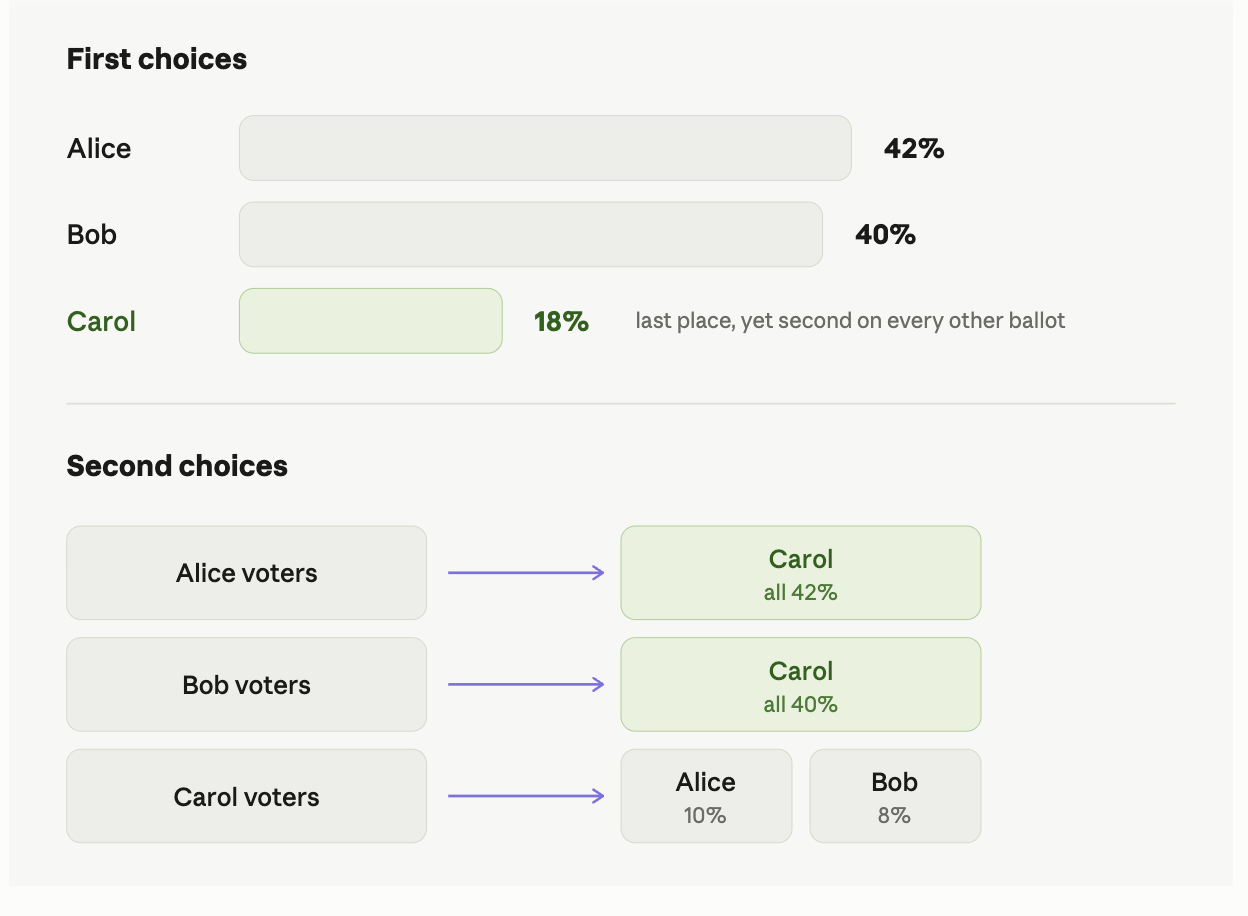
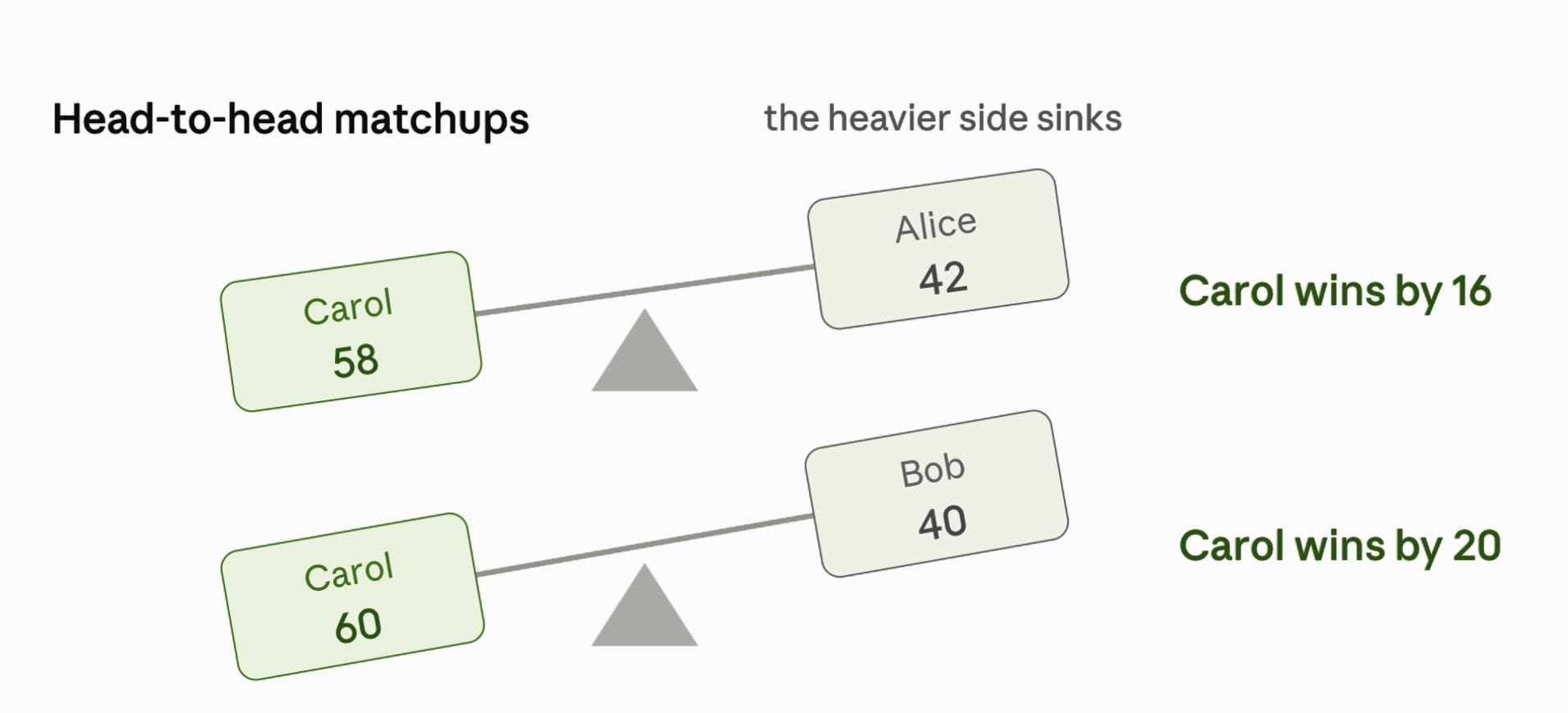
Notice how Carol would actually win a head-to-head matchup against either Alice or Bob, because all Bob voters would choose Carol over Alice, and all Alice voters would choose Carol over Bob:
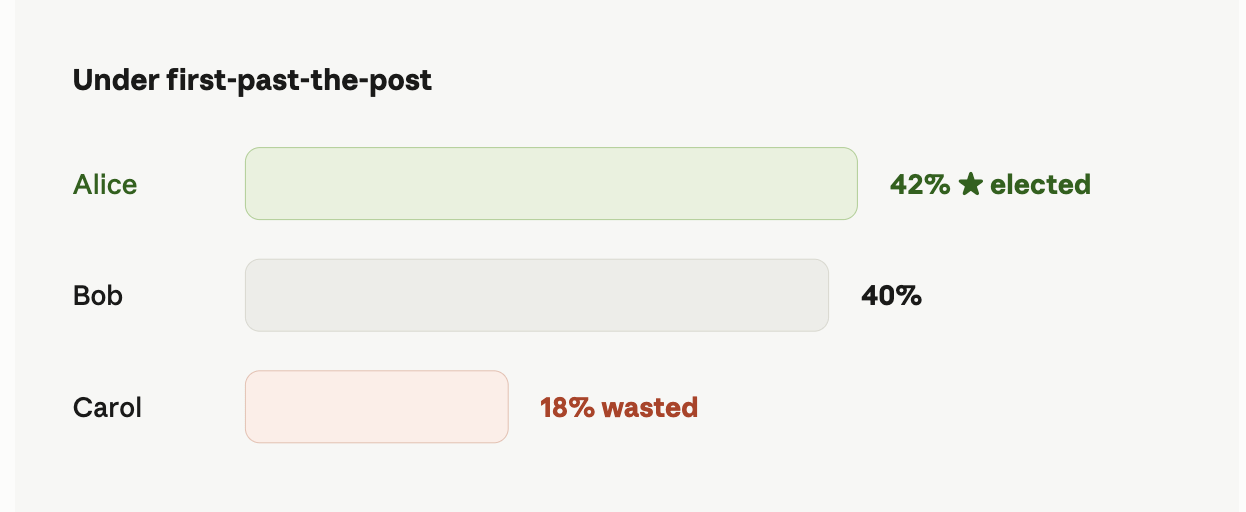
But under first-past-the-post, Carol is never going to win. In fact, Carol becomes a “spoiler” candidate: the Carol votes are wasted, and Carol voters do not get a say in the Alice-vs.-Bob matchup.
Ranked Head-to-Head Voting is a system designed to pick out Carol here.
We need more elected Carols. The US is increasingly splitting into two groups that have almost totally opposed political views, a trend taking US politics to its breaking point. This polarization is exacerbated by the standard first-past-the-post system, which forces people to band into two groups to have a chance of amassing enough votes. Electing compromise candidates would go a long way toward reversing this trend.
Ranked Head-to-Head Voting
Ranked Head-to-Head Voting is a two-round system. The first round narrows the field down to at most 4 candidates, and the second round chooses from them the head-to-head winner: the candidate that would beat any other candidate in a head-to-head election.3
The first round works like first-past-the-post, with everyone voting for a single candidate. The 4 candidates with the most votes make it to the next round. The one exception is that any candidate with less than 5% of the vote is always eliminated, so the second round can have fewer than 4 candidates if there aren’t 4 with at least 5% vote share. See the Q&A section for the rationale behind all this.
In the second round, each voter ranks the remaining candidates. A voter has to rank all remaining candidates for their vote to count. In this sample ballot, Dave is added to the example from before:
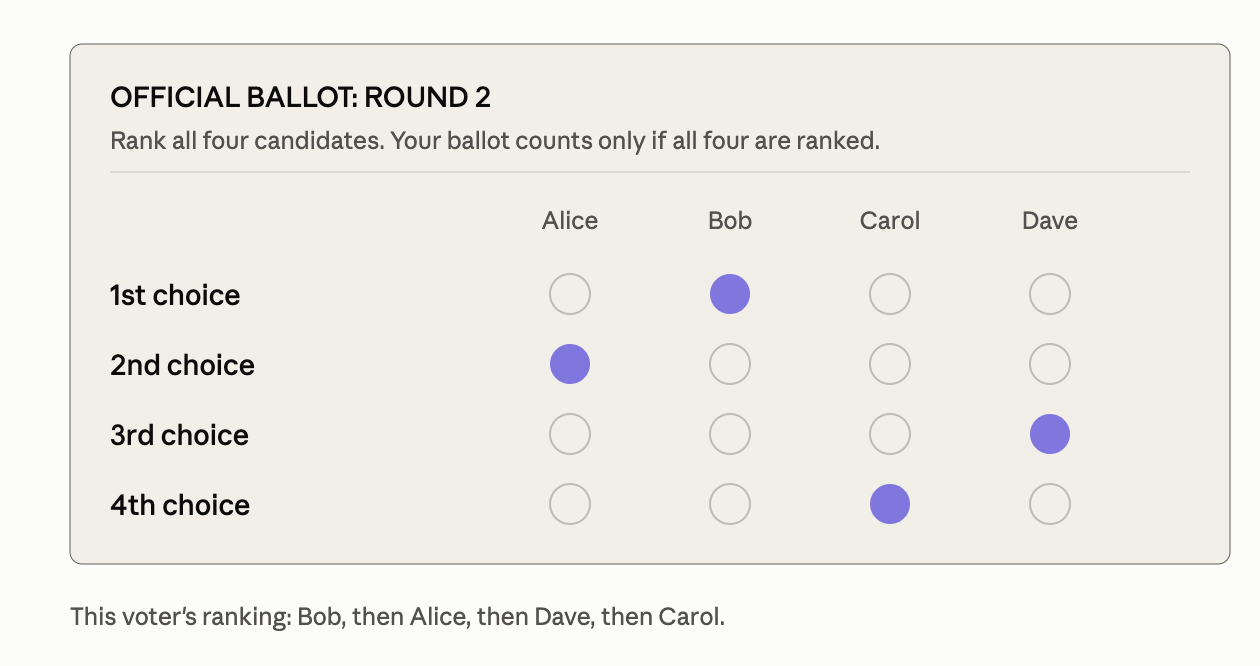
You then tally up how each candidate would do in a head-to-head election against each other candidate. Each voter’s choice in a head-to-head matchup is determined by their ranking: if they rank Dave above Carol, they count as a vote for Dave in a head-to-head against Carol:
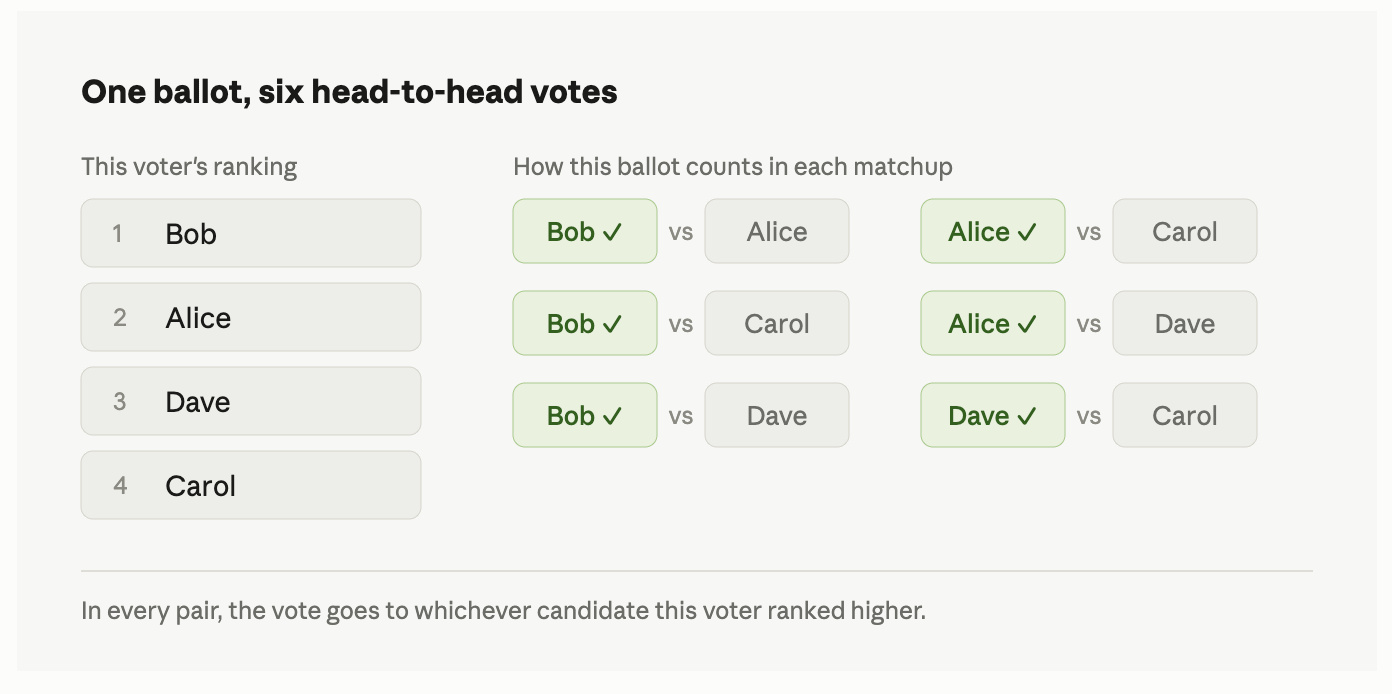
So if 60% of voters rank Carol above Bob, and the other 40% rank Bob above Carol, then Carol would win 60-40 in a head-to-head election. You can visualize all these matchups easily with a matchup table:
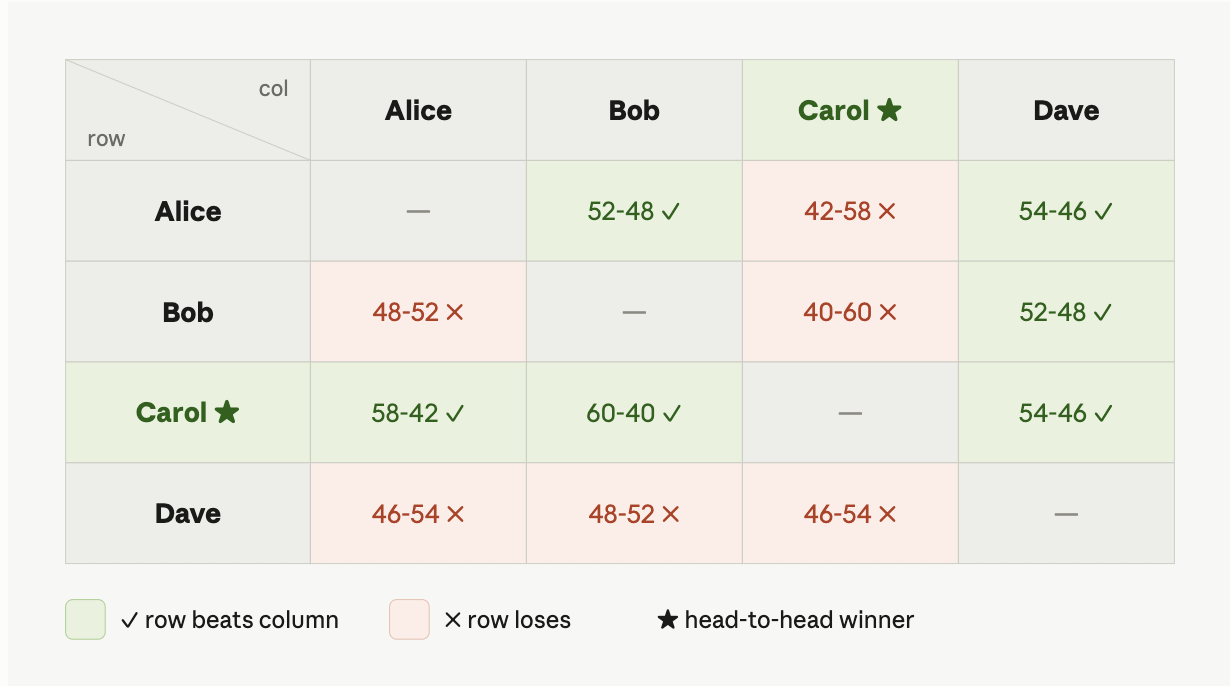
The winner is the candidate that wins a head-to-head matchup against every other candidate, shown by their row in the matchup table being all green. In this case that’s Carol.
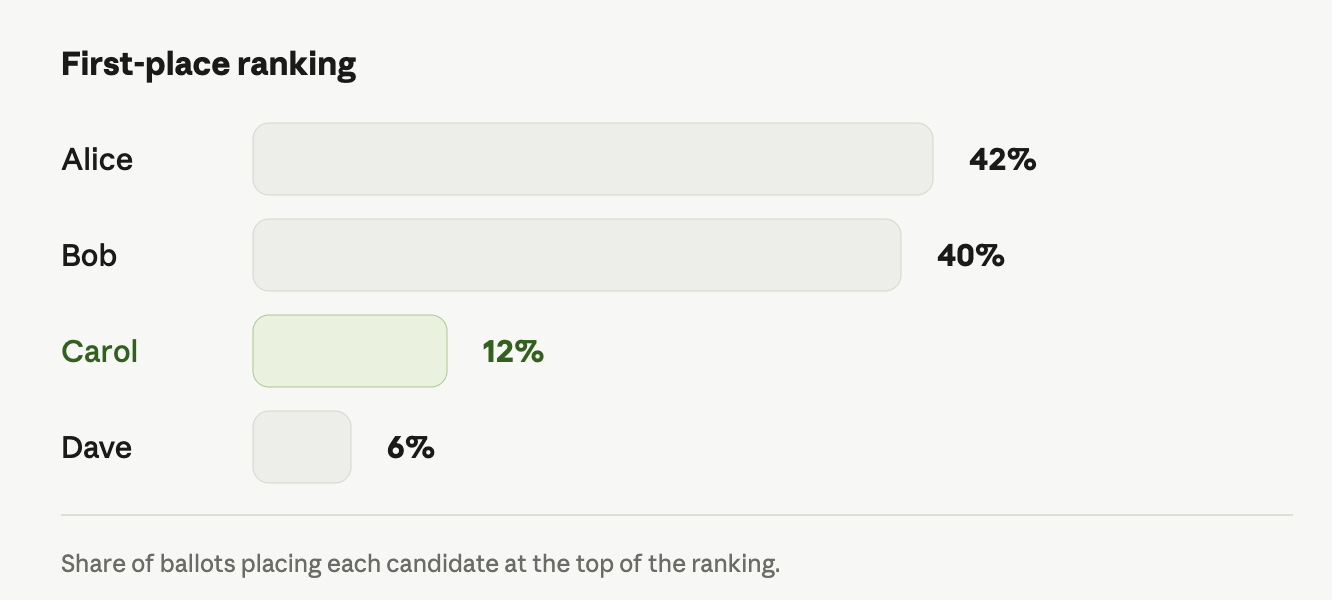
Carol here was a compromise candidate - she wasn’t many people’s first choice:
Ranked Head-to-Head doesn’t always elect a candidate with low first-choice support like this, though. If a candidate has high first-choice support and is also popular enough to beat any other candidate in a head-to-head election, then they’ll win under Ranked Head-to-Head as well:
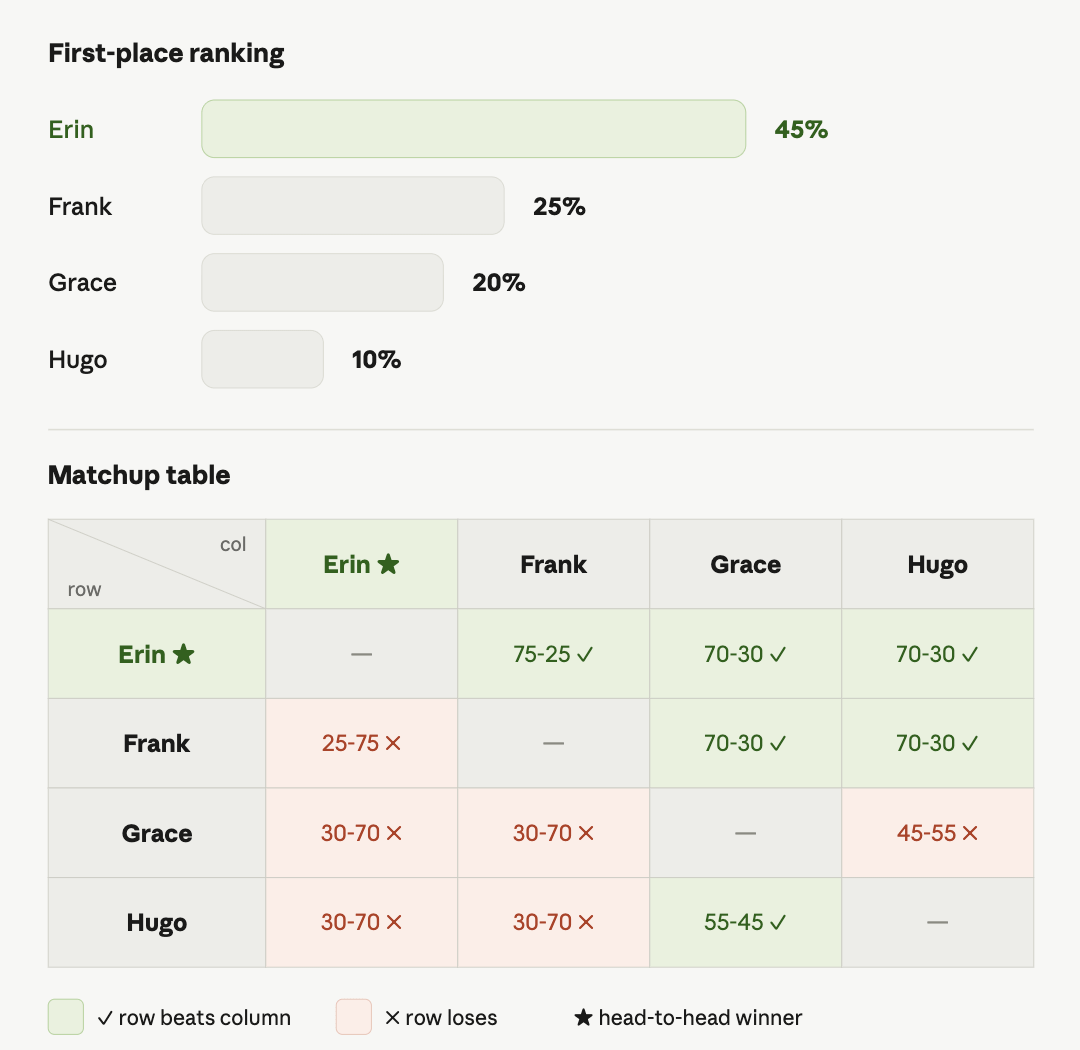
Ranked Head-to-Head just helps in the case that things are more polarized, where the candidate with larger first-choice support might not be the head-to-head winner.
“Compromise” also doesn’t necessarily mean “moderate” or “incrementalist”. A compromise candidate could be an ambitious outsider that wants to take things in an entirely different direction, maybe someone like Ross Perot in 1992. Some people have this image of a compromise candidate being a moderate who wants to preserve the status quo, but this is not always the case!
Tiebreaker: Highest Floor
Most of the time, that’s it. Occasionally, you can have no candidate winning all of their head-to-head matchups, because there is a cycle: Irene beats Jack, Jack beats Kira, and Kira beats Irene. In that case, you look at each candidate’s head-to-head “floor”, the vote share they get in their worst matchup, and pick the candidate with the highest floor4.
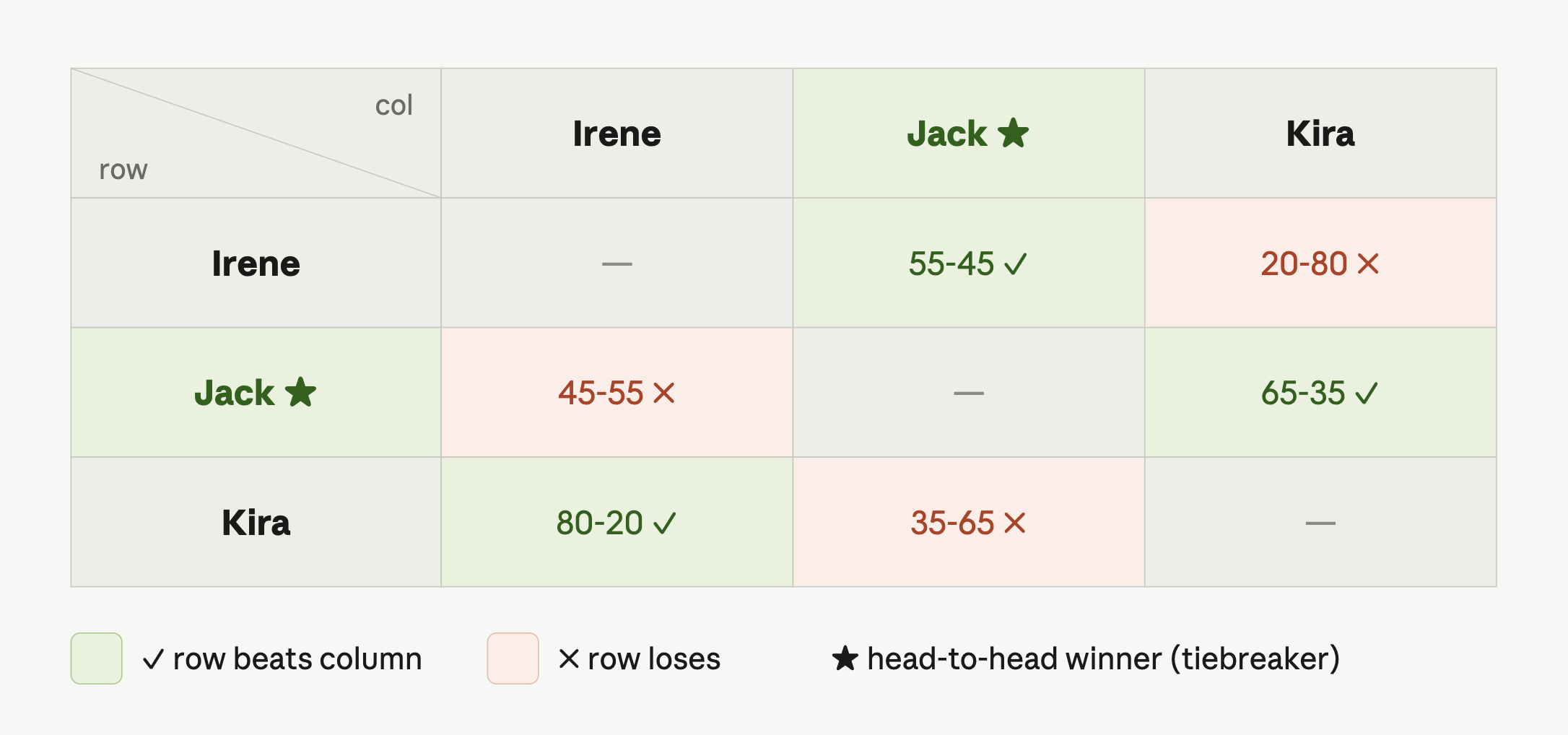
Jack here is the Ranked Head-to-Head winner because his floor, 45% in his head-to-head with Irene, is higher than Irene’s floor of 20% and Kira’s floor of 35%.
And that’s really it! The system is not overly complicated.
Practical Use
In the US, the electoral college probably makes this system impossible to implement for presidential elections. The intended use cases are congressional elections (especially Senate) and lower-level executive elections (governor, county executive, mayor).
Ranked Head-to-Head Voting is recommended in the US as a replacement for primaries, so all candidates from all parties run on the first round ballot, in addition to any independents. This two-round, top-4 system replacing primaries is already being used by Alaska (though not with head-to-head voting for the second round), so it has precedent. Using Ranked Head-to-Head in addition to primaries, while possible, forces people to show up to vote many times in what are often already low-turnout congressional elections.
For lower-level legislative elections (state assembly, city council, etc.), and for parliamentary democracies outside the US, a different approach called proportional representation is recommended instead. The US House is a special case where some form of proportional representation is potentially workable but probably hard to implement5, making proportional representation and ranked head-to-head both defensible systems to advocate for.
Q&A
Why Not Ranked Choice Voting?
Ranked Choice Voting (RCV) is the most popular alternative voting system to first-past-the-post. While Ranked Choice helps with spoilers, it does not elect compromise candidates in the same way as Ranked Head-to-Head.
Take the case from before:
The point of Ranked Choice Voting is that, after Carol is eliminated during the first step because of her lower vote total, all of Carol’s votes get redistributed to the Carol voters’ second choices instead of being wasted:
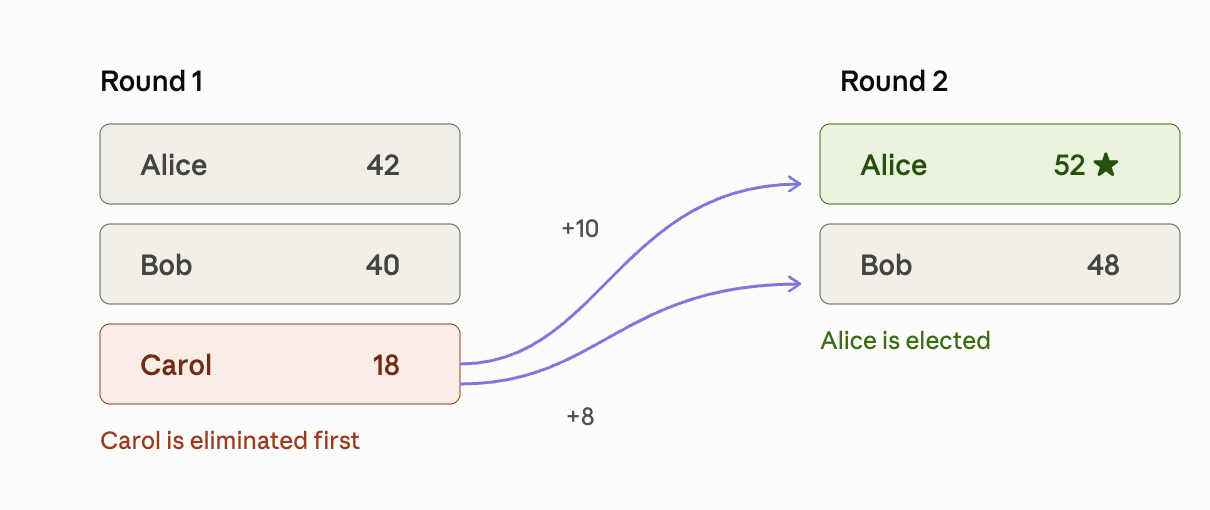
But Ranked Choice Voting still doesn’t lead to Carol getting elected! It helps with the spoiler aspect, but does not elect the compromise candidate.
Why not [other voting system]?
Read this post for in-depth discussion of the different voting systems (including top-2, score and approval voting, and STAR) and the advantages of ranked head-to-head.
Why Mandatory Ranking?
Without mandatory ranking, in practice many people rank only a top choice and do not bother with the full ranking. This type of partial ranking is called bullet voting.
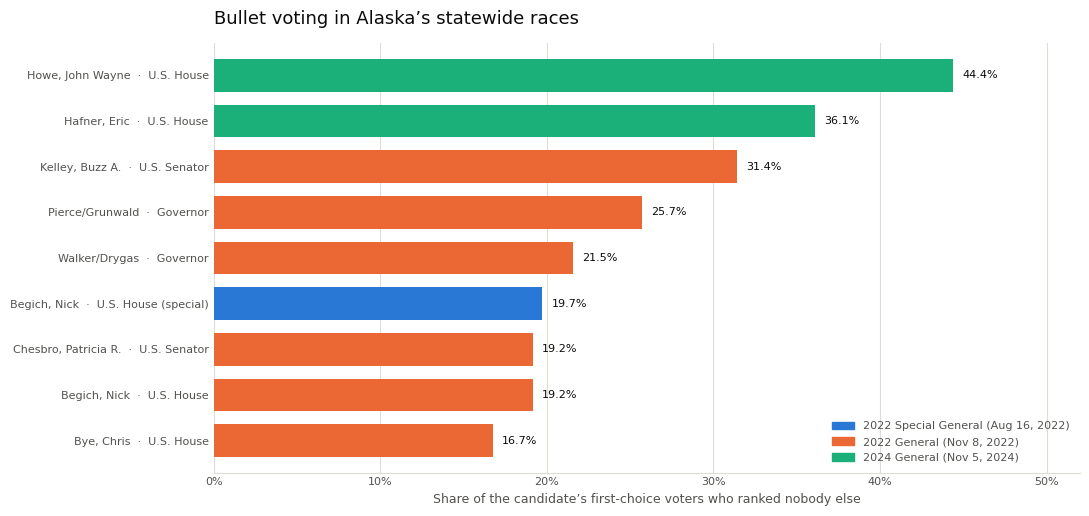
You can see this in Alaska and Maine’s ranked choice voting results. Since 2022, Alaska has used a two-round top-4 system like the one described here, with the second round using ranked choice voting. Below is a graph showing the amount of bullet voting in Alaska. It plots the percent of each candidate’s first choice voters that did bullet voting, for all candidates that did not become one of the two finalists6. As you can see, Alaska sees in most cases upwards of about 20% of these candidates’ voters doing bullet voting:
Since 2018, Maine has used ranked choice voting for federal elections without a two-round system, though it’s only been relevant in their second congressional district. There too upwards of 20% of people voting for non-finalists did bullet voting:

Bullet voting would be a big problem in ranked head-to-head. Ranked Head-to-Head depends on all of the cells in the matchup table being accurate: if a large fraction of people rank neither Alice nor Bob, that could lead to an inaccurate picture of the head-to-head matchup between them.
Bullet voting also leads to bad incentives for candidates. As in ranked choice voting, it can cause candidates to drop out of the race so they don’t become spoilers, though the exact meaning of the word “spoiler” is more complicated in ranked head-to-head.
Why two rounds?
Mandatory ranking also reveals why there are two rounds. With only one round, there can be too many candidates for a voter to realistically make an informed ranking.
In Australia for example, they have ranked choice voting for their House of Representatives, and voters are forced to rank all candidates for their vote to count. Voters there see an average of about 8 candidates7 on their ballot. Voters forced to rank 8 candidates are bound to give uninformed choices for many spots on their ranking, leading to a worse and less democratic process overall.
One consequence of this two-round system is that voters may be pushed to vote strategically in the first round rather than putting their genuine top choice. If their top choice has no chance of making the second round, their best strategy would be uniting behind one of the candidates that do have a chance. Unfortunately, there is no easy way around this. You need voters to unite around a few candidates at some point, and the second round still provides plenty of opportunity for true preferences to shine through.8
Why the 5% cutoff?
The 5% cutoff is used for similar reasons as the top-4 part. A candidate with less than 5% of the vote is very unlikely to win the second round anyway, and forcing voters to consider them just puts more burden on voters, leading to more uninformed choices.
Why the “highest floor” tiebreaker?
There are many possible tiebreakers to use. Highest floor is chosen as a simple approach that fits well with the “compromise candidate” rationale of the system. A candidate with a high floor doesn’t lose too badly against anyone, and so should be someone most people can tolerate. Tiebreaks should be rare anyway - they require a very specific configuration of voter rankings unlikely in real elections - and highest floor generally doesn’t encourage strategic voting that could lead to tiebreak situations.
The different parts of this system have been proposed before, but the exact combination and terminology are new.
It is technically possible if voters are very strategic, but this tends to be rare, and strategic voting is generally a sign that your voting system is not working as intended.
The technical name is “Condorcet”, but head-to-head is used as a clearer and more intuitive name.
The technical name is “Minimax”, but again “highest floor” is clearer and more intuitive.
Specifically, the type of proportional representation potentially workable is direct multi-member voting systems like Single Transferable Vote (STV). See this piece for more discussion.
For Ranked Choice Voting, bullet voting for one of the two finalists is not an issue, as the other candidates get eliminated in early steps anyway. For ranked head-to-head it would actually matter.
You could implement a form of ranked choice voting for the first round, but this is too confusing, since the first-round and second-round rankings would be used differently.
Great article! I’m on full support of ranked head to head. My only note is that you say there’s no easy way to prevent people having to strategically vote in the first round. It might not be a good idea from an advocacy / complexity pov but this does seem like a use case for RCV. In the first round set a threshold of 25% to advance. Then eliminate lowest candidate and redistribute “extra” votes above 25% until you have only 4 remaining.