
This is a post in my constitutional design series
I’ve previously covered the topic of electoral systems, different ways of deciding which party wins spots as leader or in the legislature. But this is only half the problem of how politicians are elected. The other half, less discussed but in my view equally important, is how you decide which candidates the parties put forward. That’s what this post is about.
Why This Post Exists
In most countries, candidate selection is left to the parties themselves. So that’s it, just let the parties decide - post over, right? Not so fast.
Even if you let the parties themselves decide, it’s still worth thinking about what the “best” decisions are. Many people use appeals to democracy to justify primaries or appeals to organization to justify elite selection, and it’s worth understanding how to evaluate these claims in light of broader constitutional design considerations.
There are also useful resources that the state can lend to parties for candidate selection. The state can help facilitate primaries, for instance, instead of forcing the parties to figure out how to ensure secret ballot, accessible voting, and minimal fraud. Or as another example, the state can provide financing to help candidates run campaigns.
Or maybe you don’t want to let the parties decide how to select candidates! You might think that candidate selection is important enough that it’s worth the state mandating a process to ensure that it’s good or fair.
I’ll talk about how much you’d want the state to intervene at the end of the second part, but I thought I’d preface the post with this as it’s many people’s gut reaction to this question.
The Party
Political parties are organizations with two main functions. For high-information voters, parties allow those with common political views to coalesce around specific candidates for a general election. For low-information voters, parties act as an easy tool for assessing a candidate’s political views without having to look into them further. Parties are a natural phenomenon; if they were banned, they would re-emerge informally in the form of elite endorsements.
There’s an inherent tradeoff involved in parties from a constitutional design perspective. On the one hand, you want party unity, so that voters - especially low info voters - know what the political views of the party they’re voting for are. On the other hand, you don’t want too much unity, or else you lose many of the advantages of legislatures that I wrote about (namely, that they’re pluralist and moderate). It’s particularly important that a party is not totally beholden to its leader, as this increases the randomness of a legislature’s views and can lead to dictatorship.
As often in this series, what I’d like are dials you can adjust based on your preference for diversity vs. uniformity. There are two good ones. The first is changing who selects the candidate, often called the “selectorate” in political science, coined in this paper (though I use the term slightly differently here). When you make the selectorate more exclusive, more open just to those who are engaged or connected enough in the party, you’ll tend to get more uniform views. The second is the mechanism you choose for actually turning these selectorate preferences into selected candidates. By mechanism I’m mostly talking about the electoral system - how proportional vs. majoritarian it is for a legislature, for example, or whether it’s likely to lead to the Condorcet winner for a party leader.
In this first part, I’ll talk about the different options for the selectorate and their consequences. In the second part, I’ll talk about the exact mechanisms for turning these selectorate preferences into candidates, and also discuss my recommendations. Before I do any of that though, I want to discuss the US as an illustration of important party selection dynamics, to give you a better intuition of how this stuff works.
Insights from US Candidate Selection
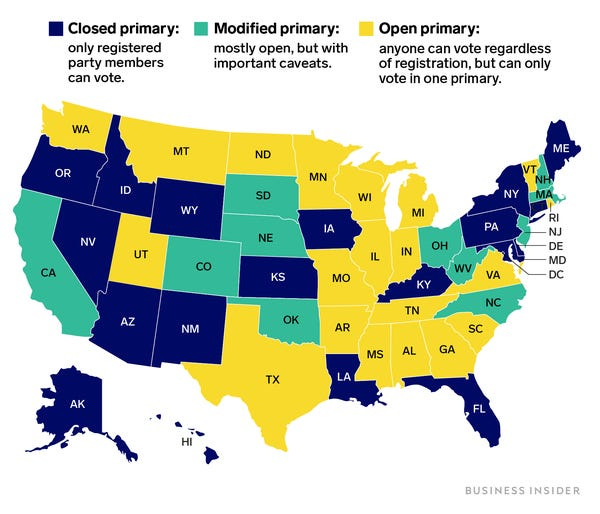
In the US, candidates are selected in primaries, public elections where anyone registered with a party (and who meets basic signature requirements) can run. Some states have “closed” primaries, where anyone registered with the party can vote, while other states have “open” primaries, where anyone can vote (but each person can only vote in one of the two parties’ primaries).
In most states that have closed primaries, registering with a party in the US is pretty easy, you just have to fill out a form some amount of time before the election, an amount which varies by state from 0 days to roughly 5 months.
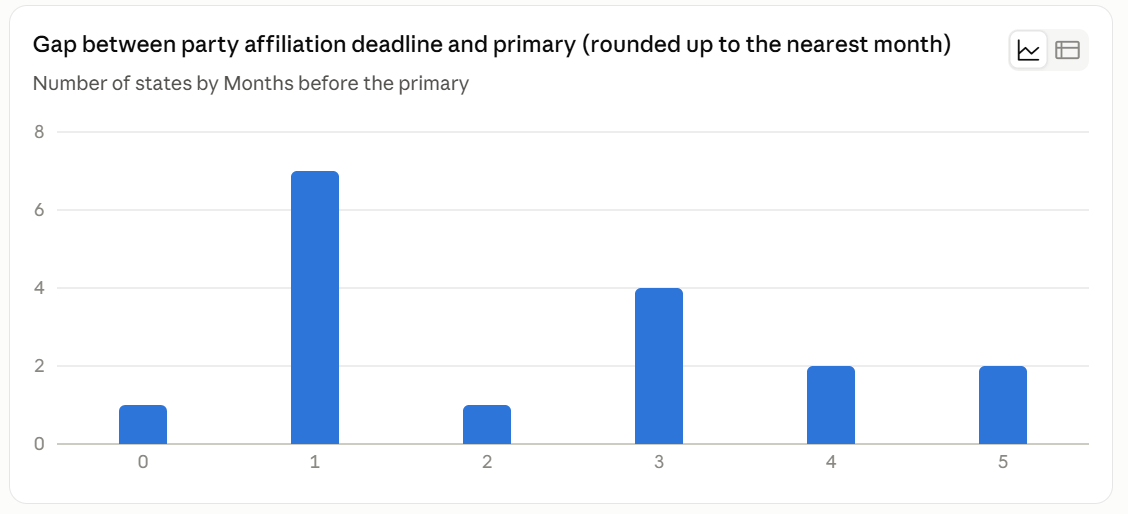
This means that in most states, anyone can basically vote in whichever primary they want, even when the primary is technically closed. Nobody has incentive to vote in the primary for the party they support; they should vote in whichever party’s primary is more advantageous.
And yet voting in the primary for the party you don’t support, called crossover voting, seems quite rare in the US. This survey paper put the number at 3-5% on average across different studies.
Why might crossover voting be rare?
I think part of it is human psychology and logistics:
People tend to have stronger feelings about their party’s candidates than about the opposition’s
I think a big part of this is that candidates tend to use messaging targeted at the groups they’re trying to attract in the primary, often using somewhat cryptic “dogwhistles” that only the target audience will fully understand.
People don’t know the procedure for changing their party registration (for closed primaries) or for voting in the opposing party’s primary (for open primaries) and don’t realize how easy it is.
People have simply never thought about the fact that they could crossover vote. People don’t really talk about it, so many have never even considered it.
People feel they’re “supposed” to vote in their party’s primaries and feel a sense of cheating if they don’t. There is a sort of norm against crossover voting.
It’s often not clear what the right strategy even is if you were to crossover vote. There is often a tradeoff between choosing someone from that party who is more palatable and someone more likely to lose the general election.
For closed primaries:
People are too lazy to fill out the form.
People don’t want to get the mail that’s sent to that party’s registered voters, as a lot of it is quite revolting to opposite-partisans.
From a constitutional design perspective, I don’t love relying on many of these psychological tendencies as the only barriers to crossover voting. Most of these can change as society evolves - crossover voting could become spoken about more openly, for example, undermining “people have simply never thought about it”. I think crossover voting is getting more common in the US, there seemed to be a ton of it in the 2024 R presidential primary, so this might really be going on. I think you should aim to create rules that are more robust.
I think there is, however, also a more “rational” dynamic discouraging crossover voting in the US, that of a coordination problem. In order for it to be worth it to crossover vote - to overcome these psychological or logistical barriers - people have to be convinced that their vote will do something. US primaries are winner-take-all, meaning they’re elections for a single candidate for the district they’re trying to represent. If crossover voting tends to make up below like 20% of a party’s primary electorate, someone’s crossover vote is never going to cause the candidate of their choice to get elected unless that candidate is also very competitive with a party’s non-crossover voters. This makes most people not motivated to pursue crossover voting, further reinforcing the coordination problem.
This coordination problem gets more acute the higher the barrier you add for people to vote in a party’s primaries. If people have to pay a fee to become a party member to vote in their primary, their bar for how much their vote has to matter for them to crossover vote will be even higher.
Now let me delve into the different choices for these barriers - ie, for who makes up the selectorate. Make sure to always keep in mind that the effects I discuss are magnified if you have a majoritarian voting system because of the coordination problem.
The Selectorate
There are two main groups that could make up the selectorate: the public - usually this means public primaries where everyone who meets some criteria of adherence to a party gets to vote - and elite selection.
Public
The advantages of having the public select the candidates are:
It’s democratic, which means the views of politicians more accurately reflect public will.
As I discussed in my piece on direct democracy, you probably don’t want politicians to be able to freeze out the public view if there’s bipartisan elite consensus on an unpopular position, and primaries are a way of preventing this.
It helps avoid “backroom politics” in deciding who gets to be a candidate, which can select for corrupt and otherwise ruthless politicians
The main drawback is that the public selects for candidates who are popular, rather than those who are better at governing in good and popular ways. In this way, it can undermine accountability democracy, as well as just generally lead to bad governance.
One other potential drawback of direct primaries from the party’s perspective is that primary winners are likely worse at campaigning for a general election. When elites choose candidates, particularly a candidate for leader, they are very concerned about winning the general election; the public not as much. Whether this is a drawback from a constitutional design perspective kind of depends on how you view campaigning.
Now I want to go over the options for who exactly makes up this public selectorate. These options differ primarily in their level of exclusivity, how much they select for engagement. As mentioned earlier, a more exclusive selectorate will lead to more uniformity. It’ll also tend to lead to more extreme candidates (see here) and candidates that appeal more to people of high socioeconomic status.
Party Voters
The most inclusive possibility for the public selectorate that is defensible in my view is everyone who votes for the party.
The straightforward way of doing this would be to host primaries where people who voted for the party last election, or maybe in the last few elections, can vote1. The hard part is checking who voted for the party. There is actually a good way of doing this that preserves secret ballot - hand voters a usb stick or barcode which contains an encoded version of who they voted for, and let them use it as they vote in the primary. But you (and the public) have to trust that the government will maintain secret ballot, and if not it can make people uncomfortable and lead to social pressure to vote for certain candidates in the general election. (Also you have to trust people not to lose their usb stick).
The other way to implement primaries for all of a party’s voters is just to use an electoral system that allows people to vote not just for a party but for candidates within that party; see my electoral system posts for more about that.
Party Members
If you find the logistical issues of party voters too difficult, or if you want a more exclusive system, you can opt for party membership as the requirement for getting a vote in candidate selection.
You want to make sure that party members are actual supporters of the party. There are a number of different requirements for becoming a party member to ensure this:
Fees
Length of party affiliation
Sponsorship by a party member (ie, someone else attests that you are a committed party member)
Party activity (attending local party meetings or campaign events)
Each of these selects for party engagement a different amount. Most also select for other attributes that I think are undesirable: fees select for wealth, sponsorship selects for sociability, party activity selects for outgoingness as well as for availability (which tends to correlate with age) and living in an area with lots of events (which tends to be urban areas, area where the party has lots of support, swing region with lots of campaign events).
The most commonly used one and the one I think you should probably opt for is fees. By paying a fee, you’re hopefully helping the party win elections, so you shouldn’t do it unless you’re actually a supporter. You’re also showing that you’re an engaged voter who is willing to pay to have more of a voice, although you’re not necessarily showing that you’re an engaged supporter of the party you’re paying a fee to.
To give you a sense of what fees look like in practice, in the countries I looked at, the base fee ranged from $20 to $120 annually, often with lower fees for certain groups (eg young people) and higher for higher income people. In most places, the fee is the only requirement for becoming a party member2.
In places where they charge a fee, party membership numbers are pretty low. Here is a chart I could find for membership in the late 1990s, and note also that party membership has been in steady decline:

There is of course the issue of poor people not being able to pay the fee. You can get around this by having the government take over the financing: charge people for party membership commensurate to their income (ie more if they’re richer), and then pay parties with government money proportionally to the number of members they have.
There is also another subtler issue, that fees may not actually help a party win elections that much, so it might be worth it to pay a fee and vote in the primary for a party you don’t actually support. You can try to get around this a bit by adopting tight restrictions on the ability of parties to raise money by other means, making the value of membership money higher, though as I talked about in this piece that might be hard to do.
Aside for fees, I think length of party affiliation is a no-brainer, with some exception for young people who cannot have been affiliated with a party for a long time. I think sponsorship by party members or party activity are options to explore as alternative routes for becoming a party member, alongside fees. I wouldn’t add these as extra requirements in addition to fees, though, because of their selection effects.
Voting at Party Meetings
Instead of making attending local party meetings a prerequisite for voting in the primary, you can have the voting take place at the local party meetings themselves. In the US these are called caucuses.
This has the same selection effects as making attendance a prerequisite for party membership. It also has the downside that you don’t have secret ballot, which means people can be socially pressured to vote for certain candidates. The main upside I can see compared to a party membership prerequisite is that it opens up potential flexibility to pursue different voting systems like single-transferable vote (STV), as you can explain the system to members before they vote and people can discuss all the candidates with each other.
I should also mention open conventions, which are like giant party meetings. Like party meetings, they have the draw of potentially opening up more advanced voting systems. They’re used mainly because they’re easier logistically than a whole caucus or primary system, but I think the massive selection effects make them just a bad option unless you really can’t do anything else, perhaps for tiny parties.
Party Elites
The alternative to letting the public select candidates is giving that power to party elites.
When a party is not new, elite selection is mostly a form of continuity. The politicians themselves choose the candidates next time (perhaps with levels of indirection, more on that below), so they’re going to be mostly the same people or at least have mostly the same views. This can be a good way of ensuring a central long-lasting party ideology. Of course these same people can change their minds on an issue, particularly if there’s incentive to do so to win the general election, but still. The only way to break this continuity is to let the public in.
With a new party, the elites are basically whoever started the party. When Nigel Farage started the party Reform UK, he and his close friends get to choose who the candidates are.
Options for Elites
There are a few different options for which elites make up the selectorate:
Party leader
Legislative party leadership
All national politicians
Local politicians.
Giving candidate selection power to the party leader is the single biggest lever for promoting uniformity within a party. One person mostly has a single set of policy stances they choose candidates based on.
You might object that because of randomness, it could be that the leader has a less “pure” version of the ideology that the party espouses, and thus it’s not the best way of ensuring a uniform vision that people can vote for. But I think people generally associate the views of the party with the views of its leader, so the leader’s ideology actually becomes the pure ideology. The leader also usually comes from the biggest faction of the party and is thus representative of the party’s majority view.
A selectorate of legislative party leadership is pretty similar, just with a few people rather than a single person. The main difference is that the party leader can be chosen by the public (more on that in a bit), breaking the continuity, while legislative party leadership never is.
A selectorate of national politicians is the purest form of a feedback loop that promotes continuity - politicians select candidates that become the party’s next politicians. (Likely with a level of indirection in between, which I’ll touch on in a bit). You can use a proportional electoral system to ensure that a party diverse in its political views stays diverse.
Finally, a selectorate of local politicians makes politicians more in touch with local issues, which might be a benefit or a drawback. How it affects big-picture factional disputes depends on how these local politicians are chosen, which opens up this same conversation but on the local level.
Indirection
Instead of having the selectorate choose candidates directly, you can have them select a candidate committee that then chooses the candidate. This is what’s done in most countries. (You can have even more layers of indirection, like having this committee choose party leadership that chooses candidates).
When the selectorate is elites, indirection is useful so they don’t have to take the time to learn about every single candidate. When the selectorate is the public, the obvious use case for indirection is when the inter-party electoral system doesn’t involve single member districts where everyone focuses just on the candidate in their own district, so you need a central committee to select a slate of national candidates. Even if you do have single-member districts though, standard primaries in geographic districts don’t allow for any ideological diversity unless certain factions are clustered geographically, so I think indirection is pretty much always a benefit.
Read on to the second part of this post, on mechanisms and recommendations!
With closed-list PR or with presidential democracy, you can even get fancy and host the general election before the primary, so first you decide how many seats each party gets / which party gets the president spot and then the parties decide which candidates takes those spots.
Beyond non-binding stuff like alleging that you support the party’s principles